Predictive maintenance that stops failures before they stop production
Use intelligent digital twins to detect early signs of equipment degradation, predict failures in advance, and plan maintenance with confidence, without relying on guesswork or calendar-based schedules.
Why maintenance teams are stuck in reactive mode
Many organizations still rely on reactive repairs or time-based preventive maintenance. Traditional approaches focus on individual signals—but predictive maintenance changes the game by understanding how assets behave over time and in context.
The reactive reality
Failures discovered too late to avoid downtime
Alarms that trigger after damage has already occurred
Maintenance performed too early—or too late
Overtime, expediting, and spare-part firefighting
Critical knowledge locked in a few experts
The predictive advantage
Detect degradation before it becomes failure
Plan maintenance based on real risk, not guesswork
Understand asset behavior across different conditions
Prevent repeat failures with intelligent insights
Transform maintenance from reactive to strategic
From threshold alarms to real prediction
This solution applies the intelligent digital twin model to a specific operational challenge. For a full explanation of the model itself, see:
What is an Intelligent Digital TwinWith intelligent digital twins, predictive maintenance is not just about monitoring sensor values. It's about modeling how an asset should behave—and detecting when it starts to drift.
In predictive maintenance, the intelligent digital twin is used to:
Represent the asset and its operating context
Learn normal behavior under different loads and conditions
Detect subtle changes that indicate early degradation
Project how risk will evolve if nothing changes
This allows teams to move from "something is wrong" to "this asset is likely to fail in X days if we don't act."
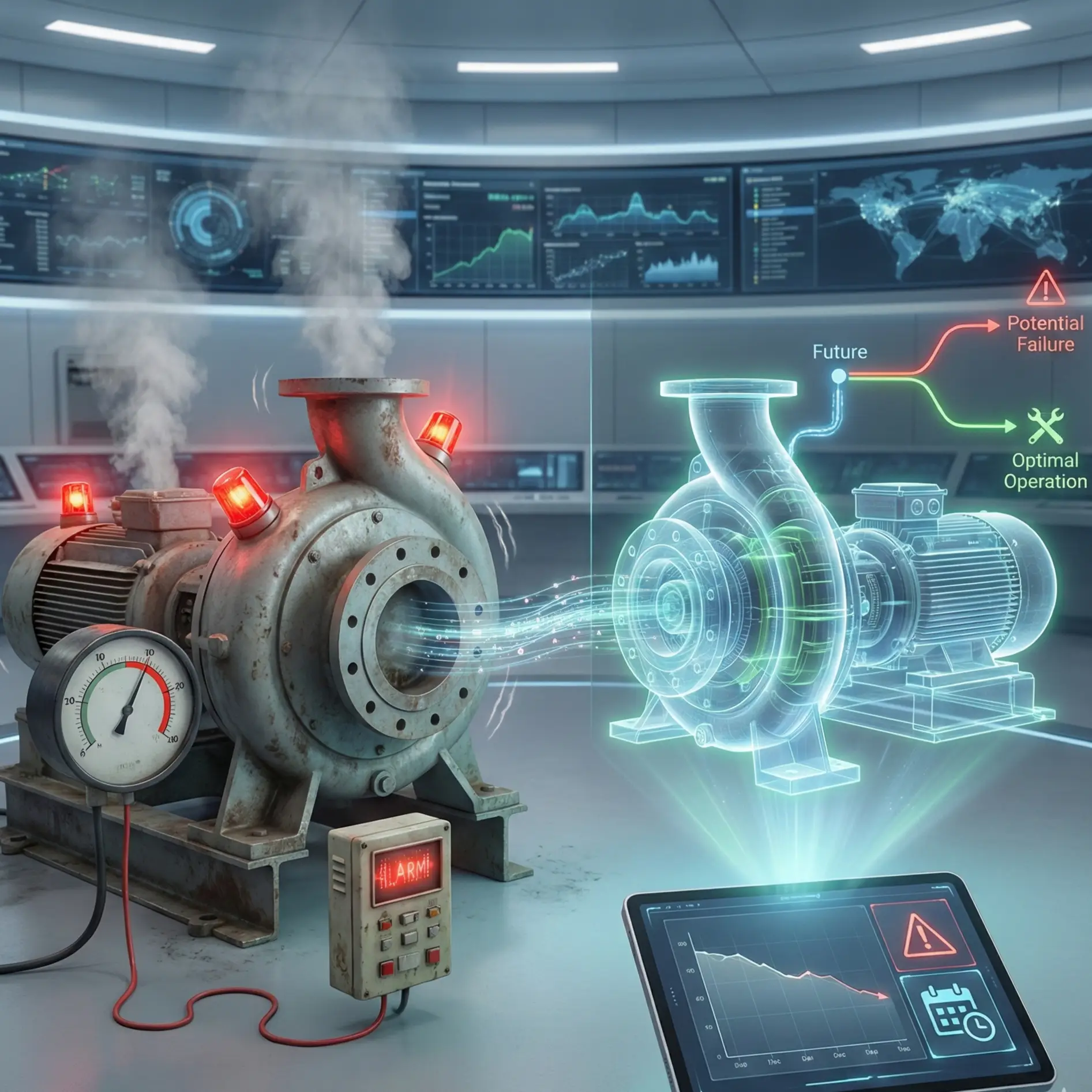
A Simple, Practical Flow
Connect existing data
Use vibration, temperature, current, pressure, run hours, and maintenance history—no need to start from scratch.
Model asset behavior
Create a digital representation of how the asset normally operates under different conditions.
Detect anomalies early
Spot deviations that don't trigger traditional alarms but signal emerging problems.
Predict failure risk
Estimate how issues will progress over time and which assets are most at risk.
Prioritize Action
Focus maintenance where it prevents the most downtime, cost, or safety risk.
Where predictive maintenance delivers the most value

Rotating equipment
(lines, assets, OEE, changeovers)
Bearing wear detection
Imbalance and misalignment
Lubrication issues

Production-critical machines
CNCs, presses, conveyors, packaging lines
Performance drift and early fault detection
Failure risk tied to production impact

Energy & utility assets
Transformers, substations, generation equipment
Asset health monitoring
Failure risk under load and weather conditions

Building systems
Chillers, AHUs, pumps, elevators
Early detection of system degradation
Reduced occupant disruption
Value across maintenance and operations roles
Reliability & maintenance engineers
See which assets are trending toward failure
Schedule work based on risk, not guesswork
Reduce emergency repairs and overtime
Operations & plant managers
Understand which issues threaten production
Plan around maintenance with fewer surprises
Improve schedule stability
Asset & engineering leaders
Compare asset health across fleets and sites
Identify chronic failure modes
Support condition-based maintenance strategies


What teams typically achieve
Results depend on asset mix and maturity, but teams often target:
20–30%
Reduction in unplanned downtime
10–20%
Reduction in maintenance cost
Days-weeks
Maintenance cost reduction
Fewer emergency call-outs and spare-part crises
Better maintenance planning and asset life extension
The biggest gains come from preventing repeat failures—not reacting faster.
Start with one asset class. Prove value. Scale.
Start
Choose a high-failure or high-impact asset (e.g., motors, pumps, chillers).
Prove
Validate early detection and prediction against real events.
Scale
Expand to additional assets, lines, or sites using the same approach.
Common questions about predictive maintenance
Prevent failures instead of reacting to them
Start with one asset that causes the most pain—and build from there.